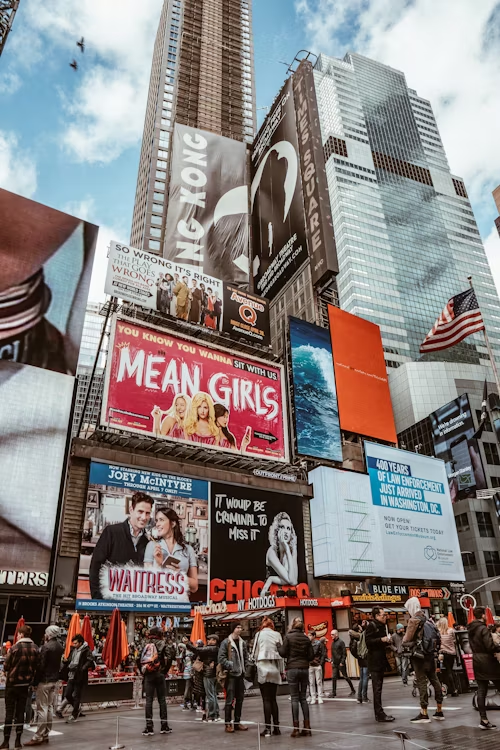
Should flyers have a lot of words?
The answer is usually no. Flyers should not have a lot of words unless the audience truly needs detailed explanation before taking action. In most cases, a flyer has only a few seconds to capture attention, communicate value, and direct the reader toward the next step. That means the strongest flyers are usually concise, visually organized, and built around one clear message rather than long blocks of text.
A text-heavy flyer can overwhelm readers and reduce response rates, especially when the flyer is being handed out, posted in public, or delivered door to door. Most people scan flyers instead of reading every line. They tend to notice the headline, the main offer, a few supporting points, and the call to action. If the flyer tries to explain too much at once, the main point can get buried. That is why concise, benefit-focused wording often performs better than detailed copy in flyer marketing.
That does not mean flyers should always be extremely short. The right amount of text depends on the purpose of the flyer, the audience, and how familiar people already are with the offer. A simple restaurant promotion, event announcement, cleaning service offer, or seasonal discount usually works best with minimal copy. A more complex service, educational event, medical offer, financial service, or business-to-business promotion may need more explanation to build trust and help the audience understand the value. Even then, the information should still be broken into short sections that are easy to scan.
A good flyer usually includes a strong headline, one main benefit or offer, a few supporting details, and a clear call to action. Instead of filling the page with paragraphs, it is often better to use short sentences, bullet points, pricing highlights, testimonials, limited-time offers, or QR codes that lead to more information online. This allows the flyer to do its main job, which is to spark interest and drive the next step, while giving interested readers a way to learn more without overcrowding the printed piece.
In practical terms, the best flyer copy is not measured by how many words it contains, but by how quickly it communicates the message. A flyer that says less, but says it clearly, often outperforms one packed with details. Businesses should focus on readability, visual hierarchy, and relevance. If extra explanation is necessary, it should support the main offer rather than compete with it.
| Flyer Style | Best Use Case | Strength | Main Risk |
|---|---|---|---|
| Short and concise | Retail offers, events, local services, promotions | Easy to scan quickly | May leave out needed detail |
| Moderate detail | Professional services, higher-value offers, community programs | Balances clarity and explanation | Can become cluttered if not designed well |
| Text-heavy | Complex educational or technical topics only | Provides more context | Lower readability and weaker engagement |
- Use fewer words when the goal is quick awareness or immediate action
- Use more explanation only when the offer is complex or unfamiliar
- Prioritize scanning with headlines, bullets, spacing, and a clear call to action
- Send readers elsewhere with a QR code, URL, or phone number if more detail is needed